Risk-assessment tutorial (1/7): methodologies
This tutorial walks through the whole risk-assessment module with one example: Construcciones Acme S.L. assesses its Coslada warehouse and its Alcobendas construction site. The first chapter explains how the assessment method is chosen and how to create your own.
1. Choosing the methodology
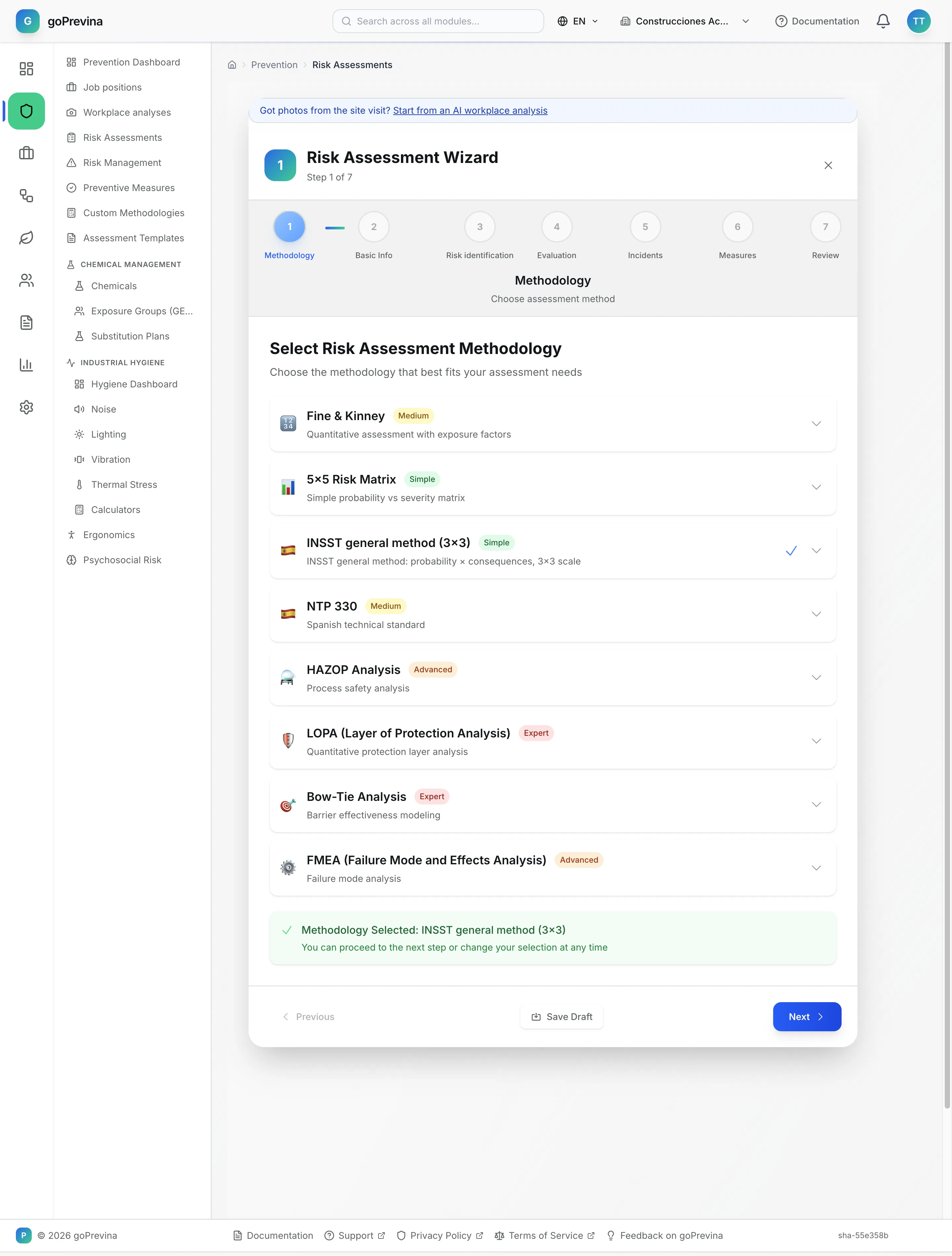
The first step of every assessment is the methodology. The wizard offers, among others, “Fine & Kinney”, “5×5 Risk Matrix”, “INSST general method (3×3)” and “NTP 330”, plus process methods such as HAZOP, LOPA or Bow-Tie. Each card shows its difficulty; expand it to see its factors.
The example uses the INSST general method: probability and severity from 1 to 3.
2. How the risk level is calculated
The application calculates each risk's score and level from the values you choose, and saves them when you finish.
INSST general method: probability (1 to 3) × severity (1 to 3). A score of 1 is “Trivial”, 2 is “Low”, 3 or 4 is “Medium”, 6 is “High” and 9 is “Critical”.
5×5 Risk Matrix: probability (1 to 5) × severity (1 to 5). Up to 3, “Trivial”; up to 6, “Low”; up to 12, “Medium”; up to 16, “High”; over 16, “Critical”.
Fine & Kinney: probability × exposure × consequences. Up to 20, “Trivial”; up to 70, “Low”; up to 200, “Medium”; up to 400, “High”; over 400, “Critical”.
The assessment's level is that of its most severe risk, and each risk's priority follows its level: “Low” for trivial and low, “Medium”, “High” and “Critical”.
3. Creating your own methodology
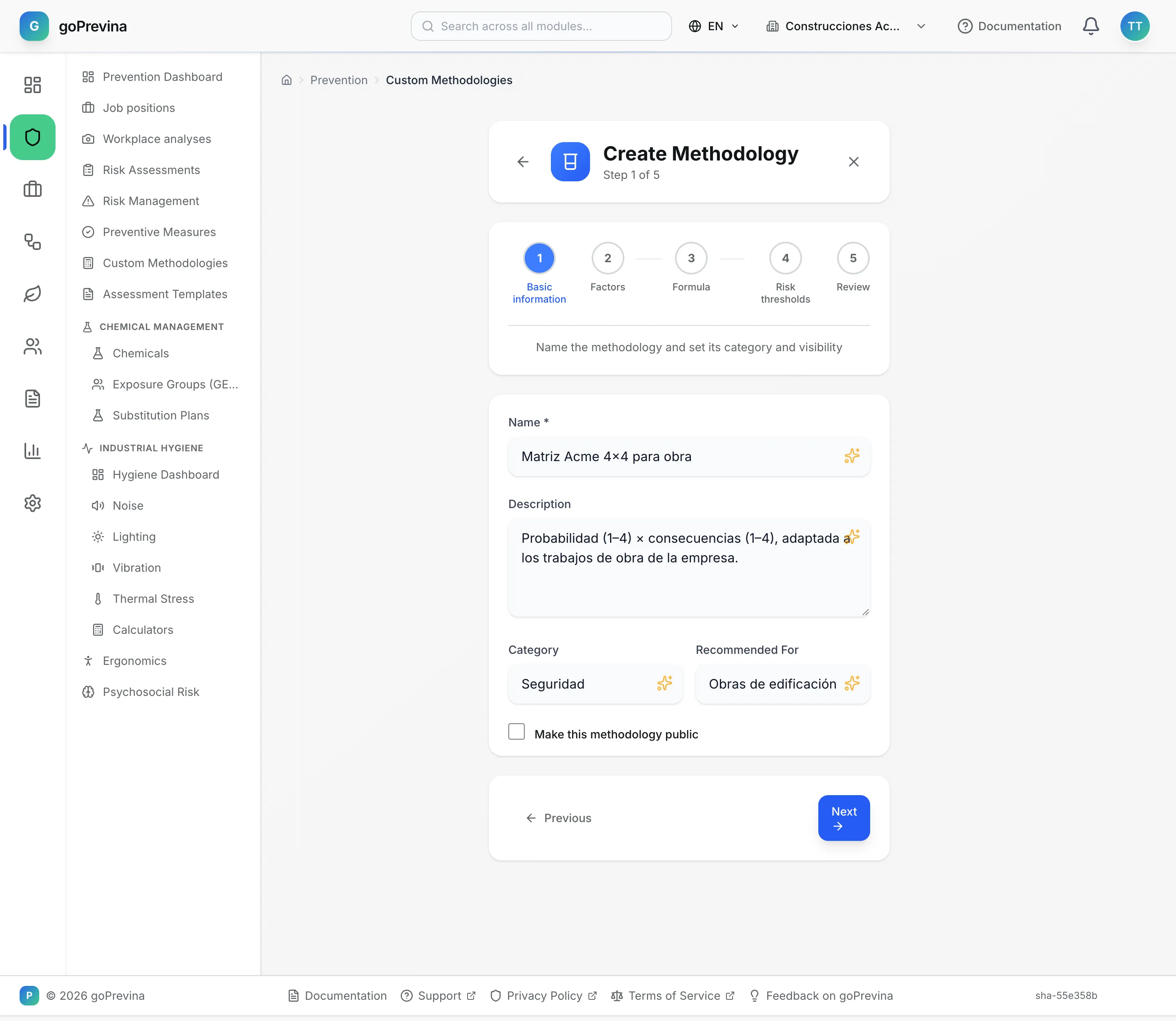
If the company uses its own method, create it under «Prevention» → “Custom Methodologies” → “Create Methodology”. The form has five steps: “Basic Information” (name, description, category and what it is recommended for), “Factors”, “Formula”, “Risk thresholds” and “Review”.
In “Formula” write the calculation with the factors you defined and press “Test Formula” before going on. In “Risk thresholds” set which score corresponds to each level.
For now, custom methodologies cannot be chosen in the assessment wizard: they document the company's method.