"What is due this week?": a Monday routine with Nora
goPrevina team ·
Whoever runs a small business does not forget about health and safety because they do not care. They forget because Monday starts with a lorry that has not turned up, a customer on the phone and someone off sick. And the health check that was due in November turns up in December, when it is already late.
This article sets out a short routine, ten or fifteen minutes a week, so that stops happening. You do not need to be a safety professional. You need to look at one list every Monday and decide three or four things.
What arrives on Monday morning
Every Monday at eight in the morning, in your company's time zone, Nora, the goPrevina assistant, leaves you a summary in the notifications bell and sends it to you by e-mail. The summary has two parts: first what falls due in the next 30 days, then what is already late. Each line says what it is, when it is due and the date to act by, which is the day you should get going on it to be in time.
That act-by date is the most useful part of the summary. A health check is due on the 30th, but if the clinic takes three weeks to give you an appointment, the day to act is much earlier. The same goes for a refresher course or for an inspection of a piece of equipment carried out by an outside company.
If the list is long, the e-mail shows the first lines and tells you how many more there are. The button at the bottom takes you to the panel with the full list.
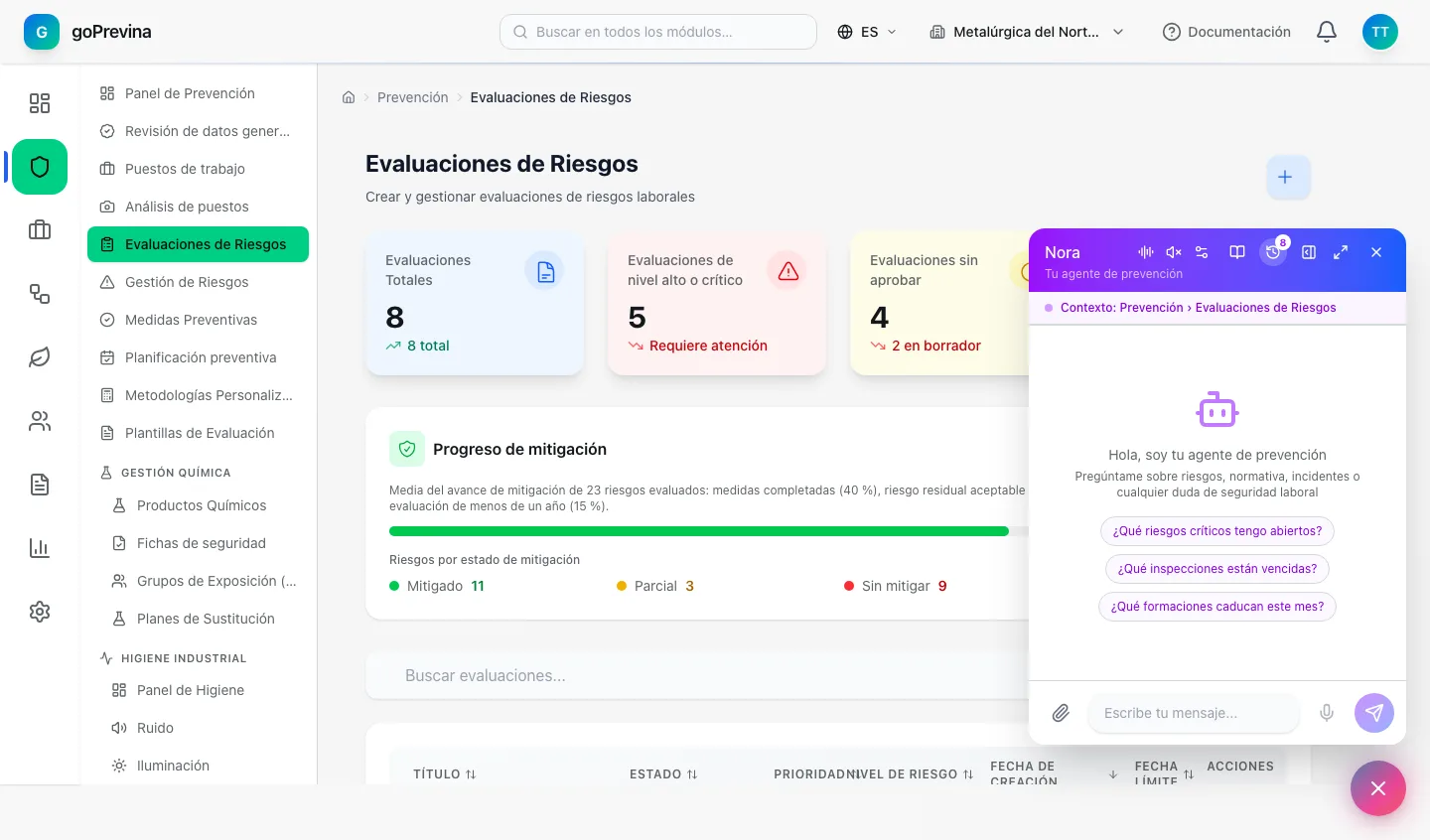
The routine, in five steps
- First, what is late. Anything past its date goes ahead of everything else. Not because someone is coming tomorrow, but because it is what is not covered today: someone working without up-to-date training, a machine that has not been checked. For each item, decide who is dealing with it and when.
- Next, what needs doing now. In the Coming up panel every item has a status: late, act now or upcoming. The "act now" ones are those that will be late if they are not booked this week. Book the appointment, ask for the quote or put the name down for the course.
- Look a bit further ahead. Switch the period to 60 or 90 days once a month. That is where things that bunch together show up: five training certificates expiring the same week, or the health checks for a whole crew. Seen in good time, they can be grouped into a single booking.
- Ask Nora about what has no fixed date. Some things do not fall due on a particular day but stay open: a quality non-conformity not yet closed, a customer complaint with no reply, a missing waste record, a preventive measure not finished. Write to Nora in your own words, for example "what do I have open in quality?" or "what am I missing on the environment side this month?", and she answers with your company's data.
- Leave every item with a name and a date. The routine is finished when every point has someone dealing with it and a day. Anything left at "we'll look at it" comes back the following Monday, a little later.
What goes into the summary
The summary brings together whatever has an expiry date in the different areas of goPrevina: each worker's training certificates, health surveillance checks, scheduled inspections and other personal certificates. That way you do not have to go into each area to know what is coming.
One important point about health surveillance: the summary says that a health check is due, never its result. Each person's medical details are only seen by someone with medical access. The manager only needs to know that an appointment has to be booked.
Environment and quality work differently, because what matters there is usually what is still open rather than what falls due: waste, emissions, non-conformities, complaints, suppliers waiting to be evaluated. That is what the fourth step is for: asking Nora.
Why Monday, and why so short
There are other ways, and they tend to fail. A notice for every item, on the day it falls due, ends up muted within a week. A long monthly report is opened once and never again. A short summary, always on the same day and always in the same shape, becomes a habit. And the health and safety that works in small businesses is nearly always a habit, not a project.
If the person who gets the summary is not the one who does the work, it still helps: forward the line to the right person and ask them on Friday how it is going. What matters is that someone looks at it on Monday.
If you want to see what a week looks like for a sample company, with its due dates and its summary, try the goPrevina demo. There is nothing to sign up for.